Article 3 — Summary of the Fastest Year Ever: 2025
Let's not forget the year 2025. Besides being a blur, it brought several impactful improvements. So many things happened that it's easy to overlook them, forget them, or never even mention them. The year began with a high probability of recession and crisis. Spring's arrival wiped out volatility, more precisely around mid-May.
Markets and environments changed so drastically that 2025 proved again why relying on one or two indicators is not wise. Recession indicators created panic. Energy sectors were more volatile than the crypto market. Somehow by summer we landed in a more stable condition. Michael Burry missed more crisis predictions than Shaquille O'Neal's free throws. He also stepped down from Scion Asset Management in late 2025.
It's challenging to highlight how fast and drastically things changed. Maybe 2025 was the "fastest" year ever. From a recession-warning spring to a record high S&P 500 year-end closing, it might feel like a roller coaster on Red Bull.
April 2025 — a bloody month
- The 500 biggest public companies in the US lost a combined ~$2.5 trillion in value as investors digested President Trump's 10% to 50% tariffs on almost all imports with shock and alarm.
- The S&P 500 fell almost 5%, its biggest single-day drop since 2020, with more than 80% of its companies finishing in the red.
- The smaller-cap Russell 2000 fell more than 6%, bringing its losses to ~23% from a November 2024 high and making it the first major US stock index to enter bear market territory.
Demand for US government bonds plunged mid-April, signalling that investors may be losing confidence in America's future ability to repay its debts.
The benchmark 10-year bond yield, which moves inversely to bond prices, had its steepest spike this week since the 2008 financial crisis. The 10-year yield is more closely watched than the 30-year yield (which also spiked) in part because it influences home and auto loan rates.
A Treasury auction of 3-year bonds was met with the softest demand since December 2023. That helped drive the bond sell-off on fears of a pullback among international investors, who hold $8.5 trillion in US Treasurys (Japan and China lead the pack).
The tariff pause and the successful auction of $39 billion in 10-year notes helped temper the bond market.
Big banks made profit in the chaos
Goldman Sachs had a record-breaking quarter. Thanks to market volatility, Goldman Sachs took in its highest stock trading revenue ever over the first three months of the year, raking in $4.19 billion, a 27% jump from the same period a year before. It's not the only big bank making bank off the market chaos. JPMorgan and Morgan Stanley also recently announced record equities trading revenue for the quarter.
Even though the volatility has been a boon, Goldman CEO David Solomon noted that the uncertainty caused by the trade war is a threat to the economy. He said:
We are hopeful that feedback from companies, large and small, institutional investors and, ultimately, consumers will support an approach that will lead to greater economic certainty and long-term growth.
Gold
Goldman's gold prediction from the end of April proved quite accurate.
Gold prices have risen more than 25% this year, reaching a record high of over $3,300 an ounce. Investors tend to flock to safe-haven assets when they sense economic uncertainty. These are the assets that have historically held their value during periods of volatility, such as gold, bonds, and the US dollar.
However, this rally is stronger than usual. China's central bank has nearly tripled the share of gold in its reserves since the pandemic, while investors have been pouring money into gold-related ETFs at an unprecedented pace. For that reason, Goldman Sachs expects gold to reach $3,700 by the end of the year, or even $4,500 if investors find additional reasons to seek shelter.
Crypto
In the cryptocurrency market, Bitcoin reached an all-time high of $109,000 on January 20. By late February 2025, roughly February 25 to 28, prices had dropped sharply to $78,000 to $86,000 amid tariff fears and risk-off sentiment. This represented a 21 to 27 percent decline from the January peak. A new all-time high of over $126,000 arrived later on October 6, 2025, driven by ETF inflows.
Crypto enthusiasts had high expectations for an alt season. In simple terms, alternative coins include everything in crypto except Bitcoin. However, BTC ETFs and institutional flows favoured Bitcoin over riskier alts. Selective rallies occurred in ETH, SOL, and memes, but no broad mania like 2021 emerged.
A more interesting development is how traditional finance and global institutions entered the crypto world. As mentioned in my previous article, states and central banks opposed crypto a few years ago. Now they use and implement blockchain technologies. If you cannot beat them, buy them.
US Strategic Bitcoin Reserve
The US Crypto Reserve, officially known as the Strategic Bitcoin Reserve, was established by an executive order signed by President Donald Trump on March 6, 2025. This initiative aims to position the United States as a leader in government digital asset strategy by treating Bitcoin as a national reserve asset, similar to gold or petroleum reserves.
The reserve is funded by Bitcoin already owned by the US federal government, primarily Bitcoin seized through criminal or civil asset forfeiture proceedings. The government is estimated to hold about 200,000 BTC, making it the largest known state holder of Bitcoin globally as of early 2025. The Bitcoin in the reserve will not be sold but maintained as a store of value, effectively serving as a digital Fort Knox for cryptocurrency.
Liquidations
Even though well-known cryptocurrencies are becoming more stable, liquidation events remain extreme. About $19–20 billion of leveraged positions were liquidated in a single day on October 10–11, 2025, during the tariff shock when Trump announced 100% tariffs on Chinese imports. That event is generally cited as the largest single-day liquidation in crypto history so far, far exceeding earlier big wipe-outs from 2021 and the FTX or COVID crashes.
An interesting graph for gold fans
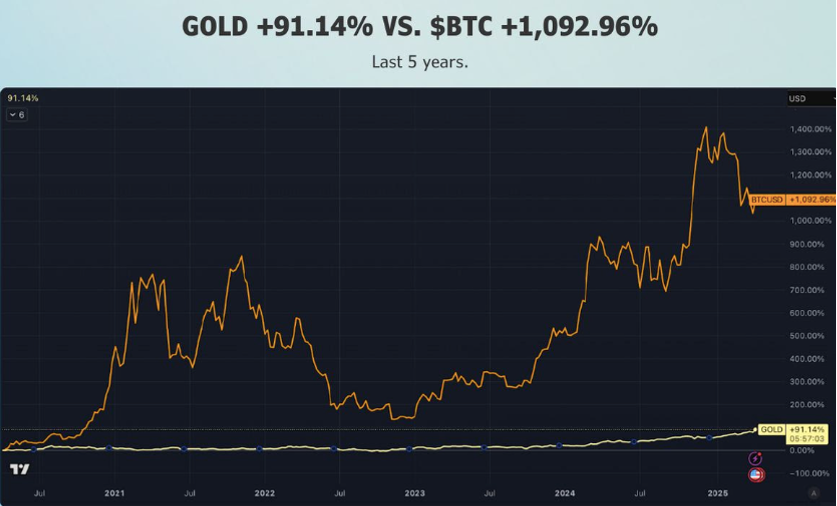
Gold delivered steady +91% growth, climbing gradually with mild volatility and peaking late in the period amid economic uncertainty. Bitcoin exploded +1093%, marked by sharp parabolic rallies (e.g., 2024–2025 surge past 1000%) but with extreme drawdowns, including multi-month consolidations.
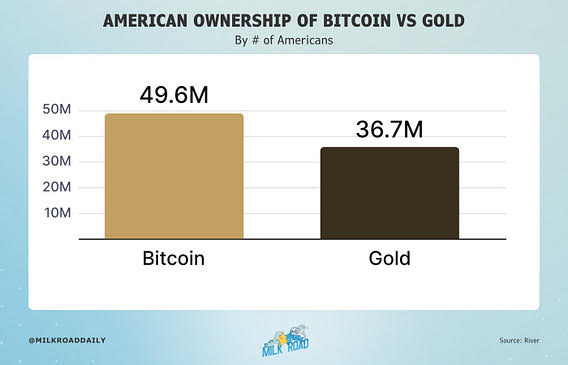
Bitcoin vs. gold ownership
Another fascinating fact is the ownership of Bitcoin versus gold. The growing preference for Bitcoin over gold partly reflects a decline in trust in traditional institutions, including governments and central banks.
Moody's downgrades the US from Aaa to Aa1
A remarkable downgrade by Moody's rating on the US credit rating from Aaa to Aa1:
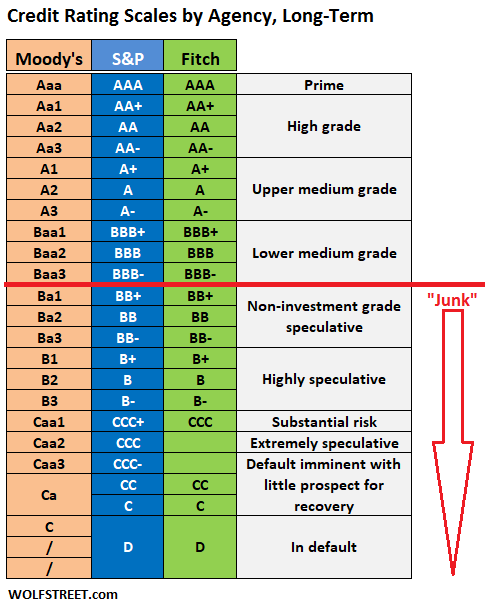
Moody's ratings assess the creditworthiness of bonds, companies, or governments using a letter scale from Aaa (safest, lowest default risk) to C (highest risk, often in default).
Aa1 is still excellent, second-highest tier, meaning very low default risk — but the drop from perfect Aaa signals reduced trust in US fiscal management due to:
- soaring debt (projected 134% of GDP by 2035),
- persistent deficits (~9% of GDP),
- political gridlock on spending/taxes.
Last year's downgrade reflects declining investor confidence in America's long-term debt repayment ability amid rising interest costs.
May 2025 — rising Treasury yields
Transitioning into May 2025, the concern was rising yields of Treasury bonds:
- The government was holding too much debt, making it a riskier lender. Investors demanded higher yields to take on government debt.
- Inflation was worse, so investors needed higher yields to compensate for the eroding purchasing power of the US dollar.
- Government spending increased, which tends to lead to higher projected economic growth and helps push yields up.
Global M2 hits all-time highs
During the summer of 2025, global M2 money supply hit all-time highs. Global M2 is the amount of money in circulation, checkable deposits, time deposits, savings deposits, and money market funds around the world. It means there was more spendable money in the economy than ever before.
The reasons were a mix of leftover pandemic and fiscal stimulus savings, big government and central-bank balance sheets earlier in the decade, and people holding more deposits rather than other investments for a time. More money available can push up demand for goods, services, and assets (stocks, houses), which can contribute to inflation or asset-price increases.
Later on, it decreased as higher short-term interest rates and higher yields on Treasury bills and money-market funds made people move money out of bank deposits into those alternatives, and tighter policy reduced new money creation.
Since 1988, when the S&P 500 gained in both May and June, a rare bullish sign, the rest of the year rose 15 out of 16 times.
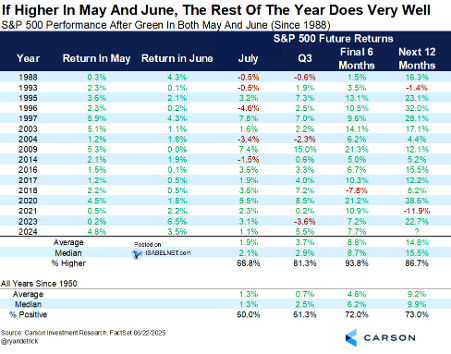
By the end of June, few could have predicted this, but the S&P 500 enters the short trading week at a record high, having staged the unlikeliest of comebacks after plummeting 19% from its previous peak in February to a low in April. Adding to the good vibes: the rally has not just been fueled by a few big tech names. For instance, Dollar General is the S&P's best-performing stock since February's high, rising around 50%.
Nvidia crosses $4T (then $5T)
Nvidia reached a $4 trillion market cap in 2025. It hit this milestone in July 2025 and later became the first company to surpass $5 trillion in October 2025, driven by AI demand, before settling around $4.3 trillion by early 2026.
Bad breakfast news
Global orange juice prices soared worldwide in 2025 due to poor harvests in Brazil (the top producer), crop diseases, extreme weather, and trade barriers. UK retail prices more than doubled over five years to £1.79 per liter by 2025 (up 29% in the past year alone), while futures hit record highs before correcting sharply into 2026. Wholesale prices tracked similar volatility, with highs up to $0.92/kg in 2024 extending into 2025 across markets like Turkey and Ukraine.
Coffee prices rose globally in 2025 from supply shortages in major producers (Brazil, Vietnam, Colombia), with Arabica up over 50% and Robusta up 25% year-on-year. This affected consumer prices everywhere, from Europe to Asia, though moderation began late 2025 as supplies recovered, with further drops forecast for 2026.
The Fed
The US central bank (the Fed) has an official dual policy mandate — "maximum employment" (low unemployment) and "price stability" (low, or at least "controlled", inflation). Around mid-August, a concerning US jobs report showed the lowest three-month jobs growth since the 2020 pandemic. The Federal Reserve faced a branching point in mid 2025, when it had to choose between supporting employment or prioritizing price stability.
The Fed leaned toward employment, cutting rates three times in 2025 despite tariff-fueled inflation, signaling downside job risks outweighed upside inflation risks at that moment. This positioned policy "well into neutral" heading into 2026.
Unemployment
In 2025, the US unemployment rate averaged around 4.3–4.4%, rising from lower levels early in the year to a peak of 4.5% in November before dipping to 4.4% in December, the highest since 2021. Layoff announcements reached 1.17 million by November, the most since 2020, driven by restructuring, AI adoption, and economic pressures.
The US rate started at about 4.2% early in the year, climbed to 4.4% by September, hit 4.5% in November, and fell slightly to 4.4% in December with 7.5 million unemployed. Globally, the unemployment rate stabilized at 4.9%, the lowest since 1991, though youth unemployment stayed high at 13% and varied widely by country. State variations were notable, with California at 5.5% and DC at 6.5% in November.
Global growth
Global GDP expanded at a gentle 2.4–3.2%, the weakest pace outside recessions since 2008, dragged by US tariffs, trade disruptions, and policy uncertainty that curbed investment and exports. While not a recession, this fell short of 2024's 3.3% and pre-tariff forecasts, with advanced economies like the US (1.6–2.8%) and eurozone (0.9%) stagnating relative to potential.
A word on AI regulation
In my opinion, the greatest risk was taking significant deregulatory steps in artificial intelligence. AI is a great tool, but without proper regulations it can lead to high risk as well. Removing regulations in such a powerful field to speed up AI developments and competition does not sound wise. Especially since it can easily reach uncontrollable levels.
Stricter regulations and infrastructure should be implemented to use AI for healthier developments before it's too late. Until prevention and safety standards are established, a significant amount of money will be spent on corruption and abuse.
Closing thoughts
In summary, the year 2025 felt shorter than a year with more events than usual. Despite so many conflicts, wars, and changes, somehow it held together. It started with a high probability of recession or crisis, then summer swept away the depression vibes. This does not mean everything is concretely stable now, as the unstable labour market, wars, and conflicts remain major issues.
Economies are changing and we are heading toward several significant revolutions. Transformation was always happening. The only difference is it is much faster now than it has ever been. Artificial intelligence is the main character in this fast conversion, making adaptation a crucial skill in the future.
An unattractive future vision might be a system where everything is in one place, on one platform. Digitalisation and AI create easily accessible and fast access to anything, making our life much easier and spending less time on time-wasting activities. However, storing all personal data, salaries, and identity on one chain or system leads to the loss of freedom. Digital ID and cashless society can be controlled and supervised at any time.
A healthy, balanced system should be created to help nations, especially individuals, have an affordable standard of living. There is insufficient effort to achieve better price stability and wage rebalancing. After COVID, liveability has worsened and does not receive enough attention to address this central challenge.
As occurred during previous depressions, a crisis is often required to increase focus on liveability and achieve significant global improvements. The saying "history does not repeat, but it often rhymes" has shown that real change is unlikely without an emergency.
If AI and other powerful tools are used wisely, society can break this repeating cycle. It will take time and effort, because several revolutions must occur to reach this new world. Society should become more aware of the cycle and focus on constructive outcomes rather than destruction.