Article 4 — Oil Crises: Past Shocks vs. Today's Iran War
The Iran–US conflict started on the 28th of February this year. The Russia–Ukraine war's full-scale invasion began on February 24, 2022. In October 1973, Arab OPEC nations imposed an oil embargo on the US and its allies to punish their support for Israel during the Yom Kippur War, slashing production by 5% monthly and targeting key importers like the US and Netherlands. This triggered a supply crunch on a tight global market with no spare capacity, causing oil prices to quadruple from about $3 to $12 per barrel within months.
All three crises — the 1973 oil embargo, the 2022 Ukraine war, and the 2026 Iran conflict — came from big political fights that cut energy supplies, causing fast jumps in oil and gas prices. Each one raised the cost of making goods and created shortages, pushing up inflation; markets reacted quickly, with 1973 oil prices quadrupling, 2022 knocking out 3–4 million barrels a day like 1970s shocks, and 2026 driving Brent crude from about $70 to over $115 a barrel.
Each hit during US political cycles: 1973 amid Watergate turmoil (Nixon resigned 1974), 2022 pre-midterms with Biden's approval tanking on energy costs, and 2026 threatening Trump's midterms via pump prices, as Iran eyes "weaponizing" oil against Republicans.
The Strait of Hormuz
What seems more serious this time is the shutdown of the Strait of Hormuz: the world's single most critical energy chokepoint, through which a fifth of global oil and gas supply flows. At the same time, drone strikes have halted operations at Saudi Arabia's biggest oil refinery and Qatar's main liquefied natural gas plant. The impact on markets has been swift. The benchmark oil price jumped 8%, while European natural gas futures spiked by as much as 50%.
The Strait of Hormuz is a tiny sea passage measuring just 34 kilometres wide at its narrowest point. It's known as one of the most critical chokepoints in global trade. Tankers haul roughly 20 million barrels of crude a day — about a fifth of the world's daily output — through the waterway, with a large chunk of it heading to China.
Europe's natural gas exposure
While crude oil is probably the most important global commodity, the impact of the conflict could prove much greater for natural gas prices, especially in Europe where the TTF benchmark has already doubled since late February, hitting levels unseen since 2025. Unlike oil, which benefits from global alternatives like US shale and diversified shipping routes, Europe's heavy reliance on LNG imports — now threatened by Qatar disruptions and Hormuz risks — leaves little spare capacity, potentially forcing rationing and industrial shutdowns reminiscent of 2022's Ukraine crisis. This vulnerability amplifies inflation risks, as gas powers a third of EU electricity and much of manufacturing, driving costs far beyond the pump.
Brent vs. WTI
Brent serves as the primary benchmark for European, African, and much of Asian oil pricing, while WTI (West Texas Intermediate) is the key benchmark for US and North American markets. Both are "light, sweet" crudes, easy to refine, but Brent comes from the North Sea (slightly heavier, more sulfur), trades globally via sea on ICE London (~60% of world oil pricing), and typically costs $2–5 more per barrel. WTI, sourced from US land fields like Texas, trades on NYMEX via pipelines and reflects domestic supply dynamics. Prices diverge based on geography and logistics: Brent's seaborne flexibility suits international demand, while WTI can lag during US gluts.
S&P during military conflicts
According to Milk Road, history shows the S&P 500 follows a typical pattern during military conflicts: an initial drop when fighting starts, usually bottoming out in days, followed by a full recovery within weeks.
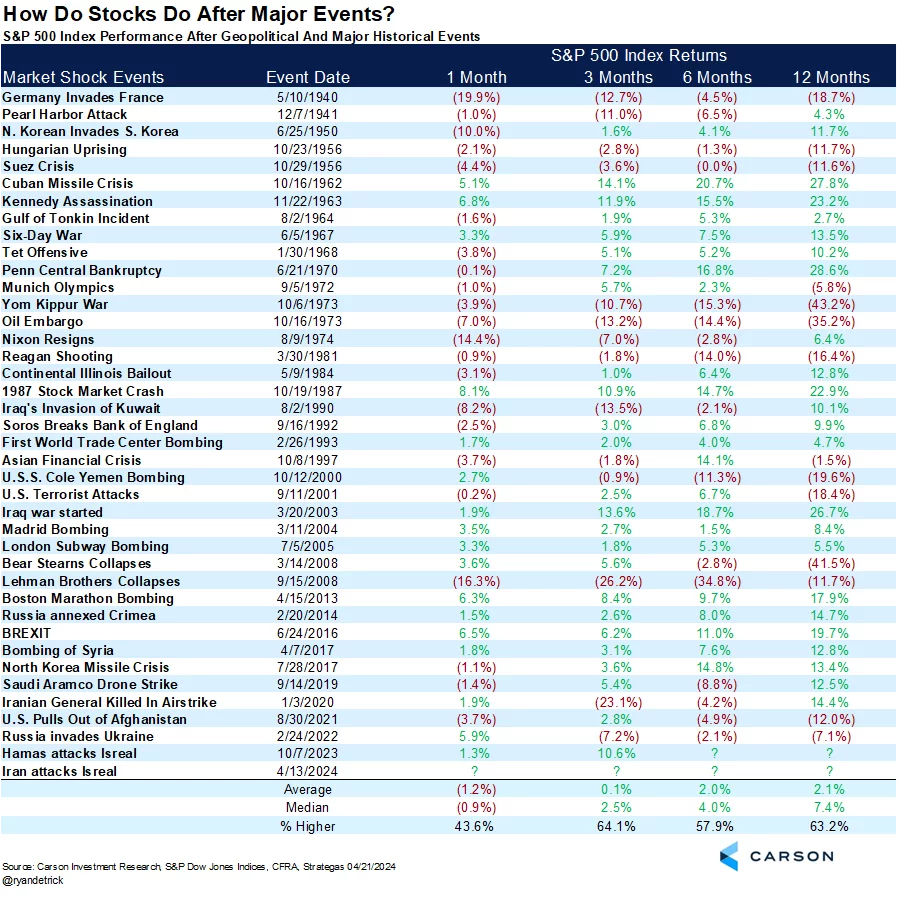
If prolonged, this scenario could spark surging inflation, weakening economic growth, and derail expectations for central bank rate cuts. Right now, market trends boil down to a simple trade-off: oil prices rise and everything else falls, or oil drops and everything else climbs.
To put it in perspective, this marks the largest oil supply shock ever recorded, 17 times bigger than the peak drop in Russia's oil output in April 2022 at the start of the Russia–Ukraine war. It surpasses the 1978 Iranian Revolution (about 9% of global demand disrupted) and the 1973 Yom Kippur War (roughly 8% affected).
Why sustained high oil is a problem
Extremely elevated oil is a big inflationary impulse, a consumer spending headwind, and a Fed rate cut killer — all at once. In terms of inflation, oil above $100 for any sustained period of time will see inflation levels surging across the world. Inflation in the US would likely rise to well above 3% in the near-future if oil lingers above $100.
Beautifully presented by Milk Road: in the past several days, Brent crude oil has generally settled around the "mostly manageable" ($80–$90) and "headwind" ($90–$100) zones.
Brent price zones
| Zone | Brent | What it means |
|---|---|---|
| Mostly manageable | $80–$90 | Can still lift inflation and hurt consumers, but unlikely to trigger serious growth or recession fears by itself unless the economy is already weak. |
| Headwind | $90–$100 | Growth starts to take a visible hit if prices sustain here. Goldman Sachs says a temporary move to $100 could shave about 0.4 pp off global growth. |
| Stagflation | $100–$120 | No longer just a consumer squeeze — it becomes a policy problem. Wider market starts worrying about growth slowdown plus stickier inflation. |
| Danger | $120–$150 | BNY analysts say if oil spikes here and stays elevated, the world economy could be significantly impacted. Commentary shifts from "macro drag" to "heightened recession risk." Closest thing to a modern breaking point — economists generally believe the US economy likely remains mostly resilient unless oil sustains at $125 or above. |
| Global shock | above $150 | Not just weaker consumption but much broader tightening in financial conditions, worsening trade balances for importers, and serious conversations about a global recession. |
These are the main reasons why oil is the most important commodity. Together with natural gas benchmarks, it illustrates where economies are heading. It is highly influenced by political events, and its price movements and levels can easily reveal the current state of a conflict.