Easy Investing: Where 20% Annual Returns Are Standard
One year ago, my first group and I started investing with a demo account. In this kind of account, users can invest with virtual money that works exactly the same way as real money. The available companies and returns are the same, and the starting amount is usually around 5,000 to 10,000 euros or dollars.
If you are afraid to use real money, or you want to test a new strategy, this is a perfect way to begin without taking unnecessary risks. The truth is that you cannot do much harm with ETFs, as many investors have already shown.
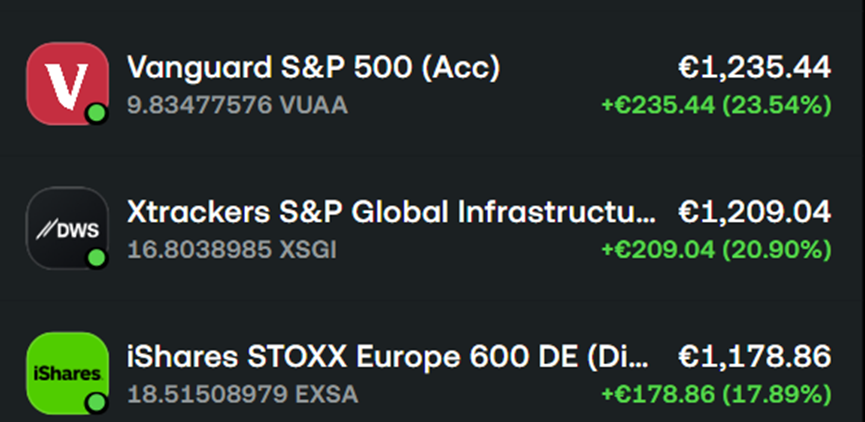
Here is my example. What I promised my group was that with ETFs, a basket of investments, a yearly return of 20 percent can be achieved. In this case, the return for the three selected investments was 20.24 percent. These are classic ETFs, not aggressive ones, but more balanced and low-risk.
This return was achieved because I did not touch the investments after putting all the money in one year ago. It was a one-time investment, and I left it untouched throughout the year. The compounding effect worked very well. (See The Power of Compounding.)
This is clear proof that you do not need to be an expert to achieve this kind of return. Many pension funds deliver less than this, often around 10 percent a year. This is a passive, invest-and-forget approach, so you do not need to do anything after the money is invested. It is one of the safest investment methods and requires almost no time once your money is working for you.
This would be the first stage in investing. An annual return of 20 percent is better than keeping your money in the bank, where the interest is so low that, in countries like Romania, your real return would be negative.
This is one of the simplest ETF portfolios. Higher returns are also possible, and with a slightly more aggressive portfolio, 25 to 30 percent yearly returns may be achievable. It depends on your risk tolerance, but that is the beauty of passive investing. You put your money in, leave it there, and let it grow.
Financial institutions often overcomplicate things and charge high fees, even for the simplest investments. In reality, the process is straightforward, but people often feel afraid or confused because of past bad experiences. In the end, you should be more worried about losing purchasing power by leaving your money in a bank or savings account.